Product Search
Find the right transformer for your needs
BMS-Cluster Series — Cluster & System-Level Management
2 Models available · Battery Management Systems (BMS)
Cluster-level BMS controllers aggregate multiple packs and coordinate with the PCS and EMS, forming the BCU and BAU layers of large storage systems.
Model Number Breakdown
- Cluster aggregation
- Active/passive balancing
- SOC/SOH tracking
- PCS/EMS integration
Specifications Range
All specifications and dimensions can be customized upon request
| Key parameters | Model Range |
|---|---|
| Cell Type | LiFePO4 |
| Cells in Series | 24 |
| Voltage Accuracy | 3 mV, 2 mV |
| SOC Accuracy | 5 % |
| Balancing | Passive 50~300mA, Active 1~5A |
| Communication | CAN, RS485/Modbus, Ethernet |
⚙How It Works
The cluster BMS scales protection and intelligence from a single pack to a whole battery cluster. It aggregates the module BMS boards, tracks cluster SOC and SOH, coordinates balancing across packs and enforces cluster-level protection. As the BCU and BAU layers of a three-level architecture, it is the bridge between the battery and the PCS/EMS, executing charge/discharge limits and reporting state to the energy management system.
▦Structure & Composition
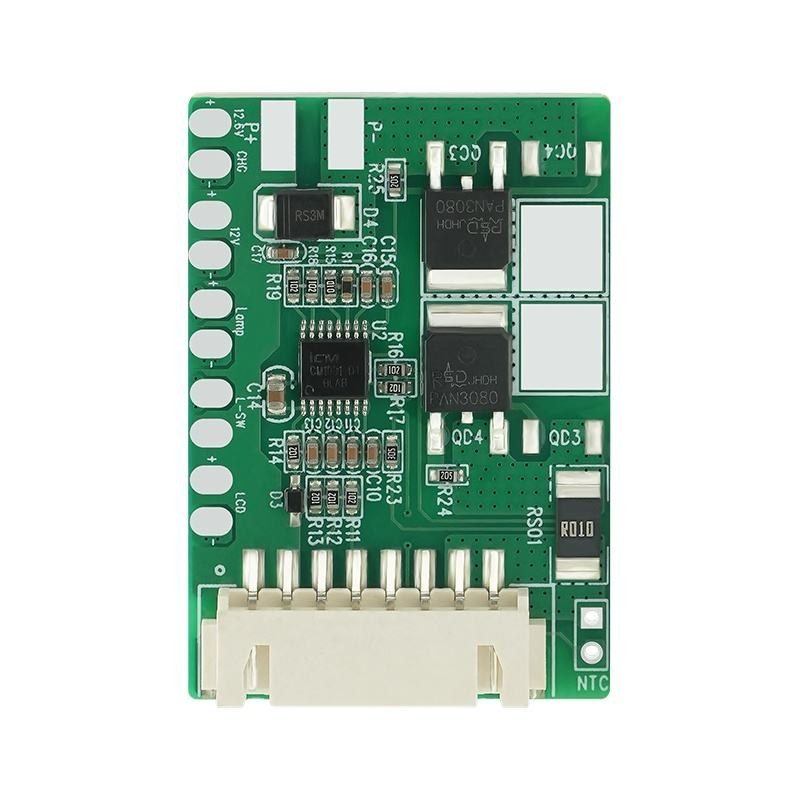
The BMS-Cluster is a controller unit that sits above the module BMS boards, wired over daisy-chain isoSPI and CAN. It samples cluster voltage, current and insulation resistance, runs cluster-level SOC/SOH and balancing algorithms, and drives the high-voltage box contactors. Redundant communication paths and a local HMI allow on-site commissioning, with Modbus TCP uplinks to SCADA.
Model Range
| Model | Cells in Series | Voltage Accuracy | SOC Accuracy | Balancing | Communication | Reference Price |
|---|---|---|---|---|---|---|
| QD-BMS-24S | 24S | 3 mV | 5 % | Passive 50~300mA | CAN, RS485/Modbus, Ethernet | … |
| QD-BMS-24S-A | 24S | 2 mV | 5 % | Active 1~5A | CAN, RS485/Modbus, Ethernet | … |
Applications
Selection Guide
- Containerised BESS, commercial cabinets and utility storage needing cluster and system-level management.
- Choose active balancing for large clusters where cell divergence grows with capacity.
- Verify the uplink protocol (Modbus TCP, IEC 61850) against the plant SCADA before integration.
Frequently Asked Questions
What is the three-level architecture?
BMU monitors individual cells, BCU manages a battery cluster, and BAU coordinates the whole system and exchanges data with the PCS and EMS.
Active or passive balancing?
Passive balancing is cheaper and adequate for small packs; active balancing moves charge between cells and suits large clusters.
What interfaces does the cluster BMS expose?
CAN, isoSPI daisy-chain, Modbus TCP and dry contacts, plus a local HMI for commissioning.
Instant Selection & Quote Calculator
Select your specifications to get an estimated price instantly.
| Base price (interpolation) | $0 |
| × Product factor | ×1.0000 |
| × Country factor | ×1.0000 |
| × Copper-linked factor | ×1.0000 |
| + Options / accessories | $0 |
Complete equipment — no winding copper linkage
Reference prices are for estimation only and do not constitute a formal offer.
We will reply with your latest quote instantly.
Solar System Configurator
Size your solar array, storage and balance-of-system, and get an instant bill of materials.