Product Search
Find the right transformer for your needs
Box-Type Substations
1 Series · 48 Models
Product Images
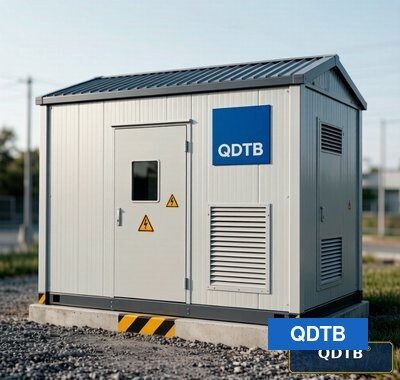
Images are for illustration purposes only
Box-Type Substations Overview
Box-type substations, also known as prefabricated substations, compact substations, package substations, or pad-mounted substations, are complete power distribution units factory-assembled in weatherproof enclosures. QDTB prefabricated substations integrate transformer, HV switchgear, and LV distribution into a single compact unit, reducing installation time and costs. European and American designs cover 100-2,000 kVA, meeting IEC 61330 and GB/T 17467. As a leading prefabricated substation manufacturer, QDTB delivers turnkey solutions for urban networks, renewables, and industry.
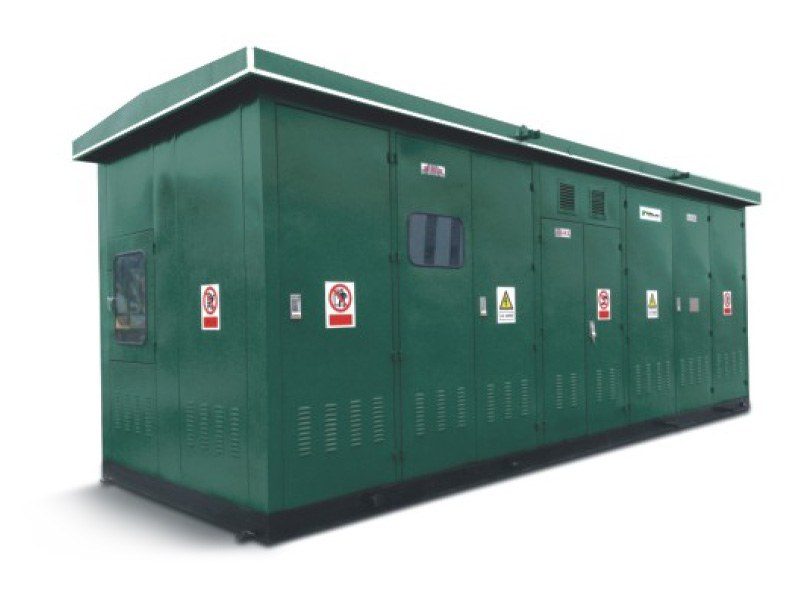
Instant Selection & Quote Calculator
Select your specifications to get an estimated price instantly.
More options(8)
Certification
The values below are computed from what you selected above. Anything that cannot be computed yet is shown as an em dash — never as zero.
Iₙ = S / (√3·U) · I_sc = 100·Iₙ / uₖ · S_sc = √3·U·I_sc · I_p = k·Iₖ
Still required to complete the calculation: rated capacity S, impedance voltage uₖ, short-time or peak withstand current.
Per-model values (P0 / Pk / uₖ declared by the factory, losses, noise, temperature rise, dimensions, weight) are not in the product library: those rows stay at an em dash until the factory parameter sheet is supplied. An em dash means the value is unavailable — it is never rendered as zero.
Read-only: no price factor, not part of the sum — the loss-grade cost is already carried by the efficiency (subtype) base price, so charging here would double-bill. Values come from the product library type-test data, interpolated between published capacities; grades the library does not cover show an em dash, never zero.
Reference prices are for estimation only and do not constitute a formal offer.
3 · Get this quote
We will reply with your latest quote instantly.
Related Engineering Calculators
Free sizing and pricing tools for this product category.
Application Scenarios
Urban Distribution
Compact prefabricated substations for city networks with fast deployment.
Wind Power
Package substations for wind turbine grid connection.
Solar Plants
Prefabricated compact substations integrating transformer and switchgear.
Industrial Parks
Factory-tested package substations reducing commissioning from months to weeks.
Commercial
Compact substations for malls and residential communities.
Temporary Power
Mobile pad-mounted substations for construction and emergencies.
Technical Advantages
Factory Tested
Fully assembled, wired, and tested before shipment for plug-and-play installation.
Space Saving
40-60% smaller footprint than conventional substations.
Rapid Deployment
Foundation to energization in days, not months.
Weatherproof
IP33D-IP44 with corrosion-resistant enclosures for 20+ year service.
FAQ - Box-Type Substations
What is the difference between European and American type substations?
How long does installation take?
What capacity range is available?
Can the enclosure be customized?
What standards do they comply with?
When should I choose a prefabricated substation over a conventional substation?
Related Product Categories
Dry Type Transformers
Dry-type transformers are essential components in modern ele
Oil Immersed Transformers
Oil-immersed transformers are the workhorse of power distrib
Special Isolation Control Transformers
Isolation and control transformers provide galvanic separati
Amorphous Alloy Transformers
Amorphous alloy transformers are the lowest-loss choice for
Reactors
Reactors are inductive components that shape power quality b
Cable Branch Boxes
Cable branch boxes are sealed distribution points that split
Ring Main Units
Ring main units (RMUs) are compact, sealed switchgear that f
High Voltage Switchgear
High-voltage switchgear performs switching, protection, and
Low Voltage Switchgear
Low-voltage switchgear and motor control centers (MCCs) deli
Single Phase Transformers
Single-phase control transformers provide galvanic isolation
Three Phase Transformers
Three-phase dry-type transformers step down, isolate, or ada
Voltage Regulators
Automatic voltage regulators (stabilizers) keep output volta
Variable Transformers
Variable auto-transformers deliver continuous, stepless AC v
Inverters
Pure sine wave inverters convert DC battery power (12 V/24 V
Dc Power Supplies
Switching DC power supplies convert AC mains into regulated
Battery Chargers
Intelligent battery chargers restore and maintain lead-acid
Motor Starters
Motor starters control three-phase motor energization with r
Ups
Online double-conversion UPS systems continuously regenerate
Power Capacitors
Self-healing power capacitors provide power factor correctio
Solar Pv Modules
Solar PV modules convert sunlight into direct current and ar
String Inverters
String grid-tie inverters turn the DC output of PV modules i
Hybrid Inverters
Hybrid solar inverters combine a grid-tie inverter and a bat
Energy Storage Batteries
Energy storage batteries store surplus solar or off-peak pow
Pcs Energy Storage
Power conversion systems (PCS) are the bidirectional heart o
Battery Management Systems
The battery management system is the safety and intelligence
Ess Fire Suppression
Fire suppression for energy storage must act in the seconds
Pv Mounting Structures
Mounting structures hold the array to the roof or ground for
Dc Cables Connectors Spd
The DC side of a PV plant is only as reliable as the cables,
Monitoring Scada Communication
A solar or storage plant that cannot be observed and control
Cables Trays Grounding
The AC side and the structural grounding of a plant are easy
Energy Storage Containers
The energy storage container packages battery, power convers
Busway
Busway (bus duct) systems distribute high-current power from
Ev Charging Stations
EV charging stations supply electric vehicles with AC Level
Pole Mounted Switchgear
Pole-mounted switchgear provides outdoor switching, protecti
Svg Svc
Static Var Generator (SVG) and Static Var Compensator (SVC)
Active Harmonic Filters
Active Harmonic Filters (APF), also called active power filt
Ats Transfer Switches
Automatic Transfer Switches (ATS) automatically transfer the
Diesel Generators
Diesel generator sets provide reliable prime or standby powe
Eps Emergency Power
EPS (Emergency Power Supply) systems provide battery-backed
Wind Turbines
QDTB onshore wind turbines span the 2 MW, 3 MW and 5 MW clas
Scada Automation
Substation SCADA and secondary automation equipment for MV/L
American Pad Mounted Transformers
American pad-mounted transformers (ZGS series) place a 12 kV
Need help?
All specifications and dimensions can be customized upon request
European Box-Type vs American Pad-Mounted vs Substation Room: How to Choose
| European Box-Type (YB) | American Pad-Mounted (ZGS) | Conventional Substation Room | |
|---|---|---|---|
| Layout | Separate HV, transformer and LV compartments in one enclosure | Single tamper-resistant enclosure with dead-front HV | Switchgear, transformer and LV boards in a built room |
| Footprint | Compact — one weatherproof cabin at grade | Smallest footprint, sitting on a concrete pad | Largest, needing a building or fenced compound |
| Site work | Factory-assembled and tested, only cable terminations on site | Placed on the pad, then HV cable and LV connections | Civil works and room construction before installation |
| HV switching | SF6 or air-insulated RMU inside the enclosure | Dead-front SF6 load-break switch with bayonet fuse | Free-standing switchgear in the HV room |
| LV distribution | LV panel integrated and wired at the factory | LV connections run to an external panel or pedestal | Separate LV boards installed on site |
| Climate | Enclosure and ventilation specified for the site ambient | Tamper-resistant cover with passive or forced ventilation | Room HVAC sized to the transformer losses |
| Typical application | Urban distribution, wind and solar parks, industrial estates | Residential subdivisions and light-industrial parks | Large plants and utility substations |
Where QDTB® Box-Type Substations Are Specified
Prefabricated substations are specified wherever the distribution point has no building to house it: urban streets, commercial car parks and industrial parks where a weatherproof cabin at grade replaces a masonry substation room and the civil programme that goes with it. The same enclosure also has to satisfy the utility's access and security rules, which is why the compartment layout is agreed before the order is released.
Solar and wind projects use them as the collector substation at the array or turbine string, because the unit arrives factory-assembled and routine-tested and can be energised days after the pad is ready. That matters when the commissioning window is fixed by the grid connection date, and it is the reason the enclosure is ordered with the transformer rather than after it.
Construction sites, mining camps and temporary power schemes choose the design for the same reason: it can be relocated when the project moves. European box-type layouts with separate compartments are the norm in IEC markets, while American pad-mounted units serve 12 kV class distribution built to IEEE and ANSI practice.
Enclosure finish follows the site: galvanised steel inland, aluminium-zinc or stainless for coastal and corrosive atmospheres, with climate control where ambient temperature or solar gain would push the transformer above its rating. Ventilation and IP class are specified together with the loss grade, because a hotter enclosure derates the same transformer.
Frequently Asked Questions
What is the difference between European and American type substations?
European (compact substation) uses separate compartments. American (pad-mounted) shares one enclosure. European offers flexibility; American is more compact.
How long does installation take?
Site prep 1-2 weeks, placement 1-3 days. Total under 3 weeks vs 3-6 months conventional.
What capacity range is available?
Standard 100-2,000 kVA; larger ratings quoted on request. Voltage: 12/0.4, 20/0.4, 35/0.4 kV.
Can the enclosure be customized?
Galvanized steel, aluminum-zinc, stainless for coastal. Decorative cladding and climate control available.
What standards do they comply with?
IEC 61330, GB/T 17467, CE for Europe, IEEE C57.12.28 for American type.
When should I choose a prefabricated substation over a conventional substation?
When you need fast deployment, a smaller footprint, or plug-and-play installation - urban networks, renewables, and temporary power. A factory-assembled and tested unit energizes in days instead of the months a site-built substation takes.